← Back to Insights
Markets & macro · Bonds
The House Doesn’t Always Win
Treasury tried to talk long rates down. The bond market answered at 5%.
The U.S. Treasury Secretary set out to push the 10-year yield below 4% and told the market he was the house. The 10-year is now trading around 5%. What that says about who really sets the price of money, why it matters well beyond Wall Street, and how we position for it.
GG
Gordon Goss, CIM PFP FCSILead Financial Consultant · September 24, 2026 · 7 min read
Treasury Secretary Scott Bessent has been trying to bring long-term U.S. interest rates down. One of his tools was the Treasury’s bond buyback programme, in which the government buys back some of its own older debt. As Martin Armstrong reported this week, the buybacks were tripled from about $2 billion to $6 billion, with the goal of pushing the 10-year Treasury yield below 4%. The message to the market was blunt: “I am the house.”
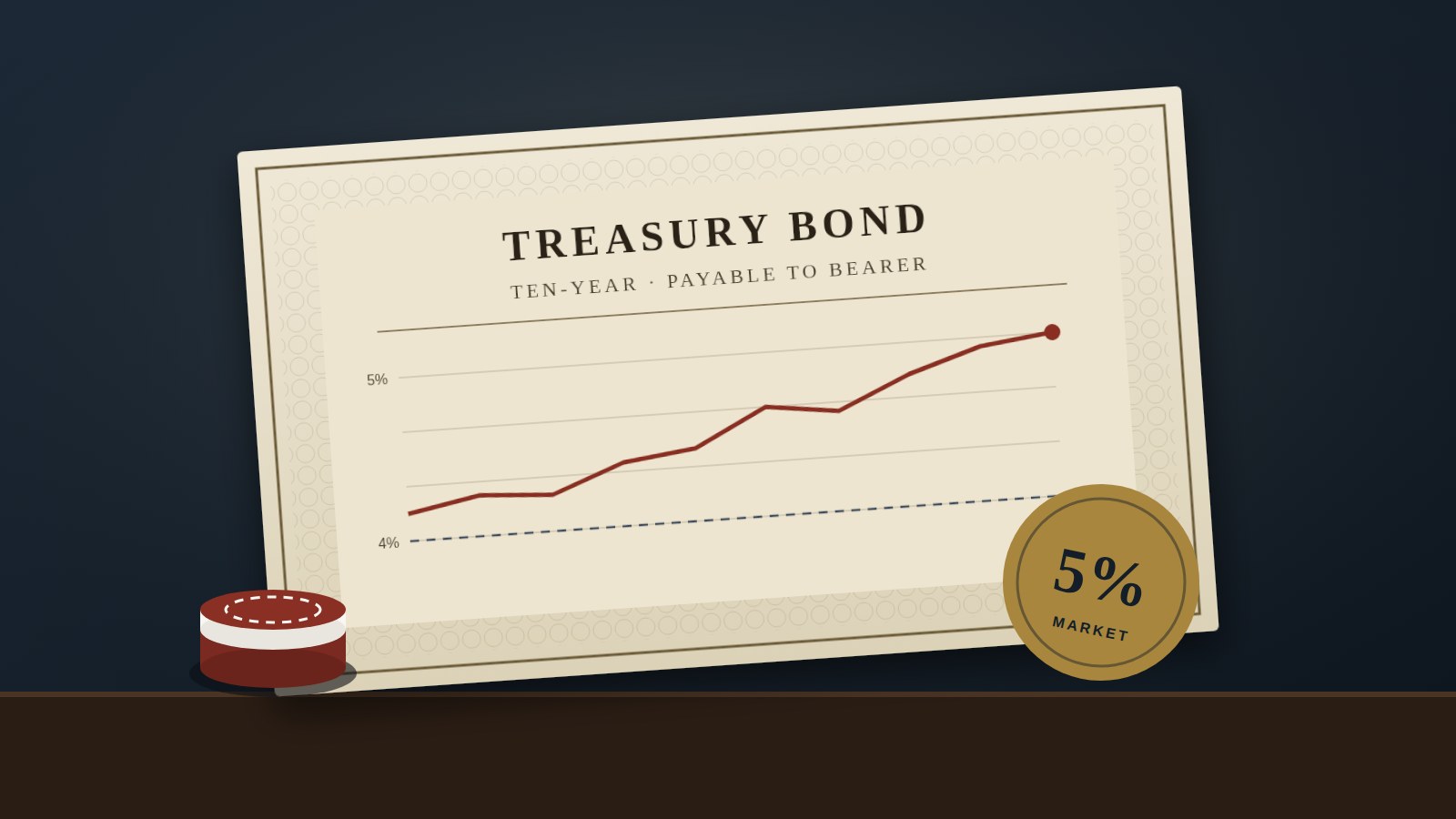
The market didn’t cooperate. Federal Reserve data show the 10-year yield closing at 5.01% on both September 16 and September 18, and at 4.96% on September 22. Armstrong puts the intraday high above 5.04%, the highest level since 2007. Instead of falling toward 4%, the government’s benchmark borrowing cost has moved a full point the other way.
Scale is the first problem. A $6 billion buyback in a Treasury market of roughly $32 trillion is about two hundredths of one percent. Armstrong’s own jab was that he has clients who could triple that in seconds. You don’t move the price of the world’s largest bond market by leaning on it with a rounding error.
The second problem is arithmetic. A buyback doesn’t shrink the debt. The Treasury pays for it by issuing other debt, while the deficit keeps adding hundreds of billions of new bonds a year that someone has to buy. The price of those bonds, which is the yield, is set by the buyers: pension funds, banks, foreign governments and investors deciding what return they need to lend to Washington for ten years, given where they think inflation, deficits and the dollar are going.
That is the real point. In a bond market, the house isn’t the Treasury. The house is the market. As Armstrong puts it, “The market is never wrong. The trend is your friend.”
Why 5% matters beyond Wall Street
The 10-year Treasury yield is the anchor for a great deal of borrowing worldwide. When it rises, the effects spread:
- Mortgages and business loans price off it, so borrowing gets more expensive for households and companies, including in places like Cayman and Dubai where lending tracks U.S. rates.
- Government interest bills grow. With $40 trillion of debt, every one percentage point of higher rates adds roughly $400 billion a year to the interest bill once the debt has rolled over at the new level. That money has to come from somewhere: more borrowing, higher taxes, or both.
- “Safe” bonds lose value. When yields rise, the price of existing bonds falls. In 2022, long-dated Treasuries lost more than a quarter of their value. Many people who thought they held the safest asset in the world found out it could fall like a stock.
Armstrong’s forecast, and the other side
Armstrong’s models say that if the 10-year closes above 5.3%, the next major resistance is 6.72% to 7.04%, which he sees as reachable by the second quarter of 2027. He compares the pressure to Russia in 1998, when its short-term government bond yields reached 150–200% before the default.
That is his forecast, not ours, and it deserves a fair counterweight. The United States borrows in its own currency, which Russia in 1998 effectively could not, so a default of that kind isn’t a like-for-like comparison. A recession could pull yields sharply lower as money runs to safety. And the Federal Reserve has other tools, from renewed bond buying to outright caps on long-term yields, which it could reach for if rates rise far enough to threaten the financial system. Those tools come with their own cost, which usually shows up as inflation and a weaker currency.
We don’t need to know which path wins. What this month shows is that the market will not simply accept whatever rate officials announce. That alone is worth building around.
How we position for it
We have written before that the traditional 60/40 portfolio leans on government bonds as its safe anchor, and that the anchor has become less reliable. That is why our structure doesn’t treat long-dated government bonds as the foundation. The assets we and our members hold instead are real ones: Argentine farmland and cattle, oil production, and allocated precious metals, with a treasury account for liquidity. They carry their own risks, stated elsewhere, but they don’t depend on the Treasury winning an argument with the bond market.
For members, a few practical questions are worth asking now:
- How much of your “safe” money is in long-dated bonds, and what would it be worth if yields rose another point or two?
- Do you have floating-rate debt, a mortgage or a business line of credit, that resets with rates?
- Is your property exposure financed or owned outright? Cash-heavy markets like Dubai, where roughly two-thirds of purchases are in cash, are less sensitive to rate moves than leveraged ones.
- Do you hold anything that benefits if officials respond with more money printing? Metals and productive real assets historically have.
What we’re watching
- A close above 5.3% on the 10-year, the level Armstrong flags.
- Demand at Treasury auctions, especially from foreign buyers.
- The Fed’s response if long rates keep climbing.
- Gold and the dollar, which tell you how the market reads that response.
Officials can set many things. The price at which the world is willing to lend them money isn’t one of them. The house, in the end, is everyone on the other side of the table.
This article is for general information only and reflects the author’s views. Forecasts attributed to third parties are theirs, not ours. It is not investment, legal or tax advice, and it is not an offer or solicitation. Interest rates, bond prices and real assets can all move against you, and real assets are generally illiquid. Seek qualified professional advice before acting.