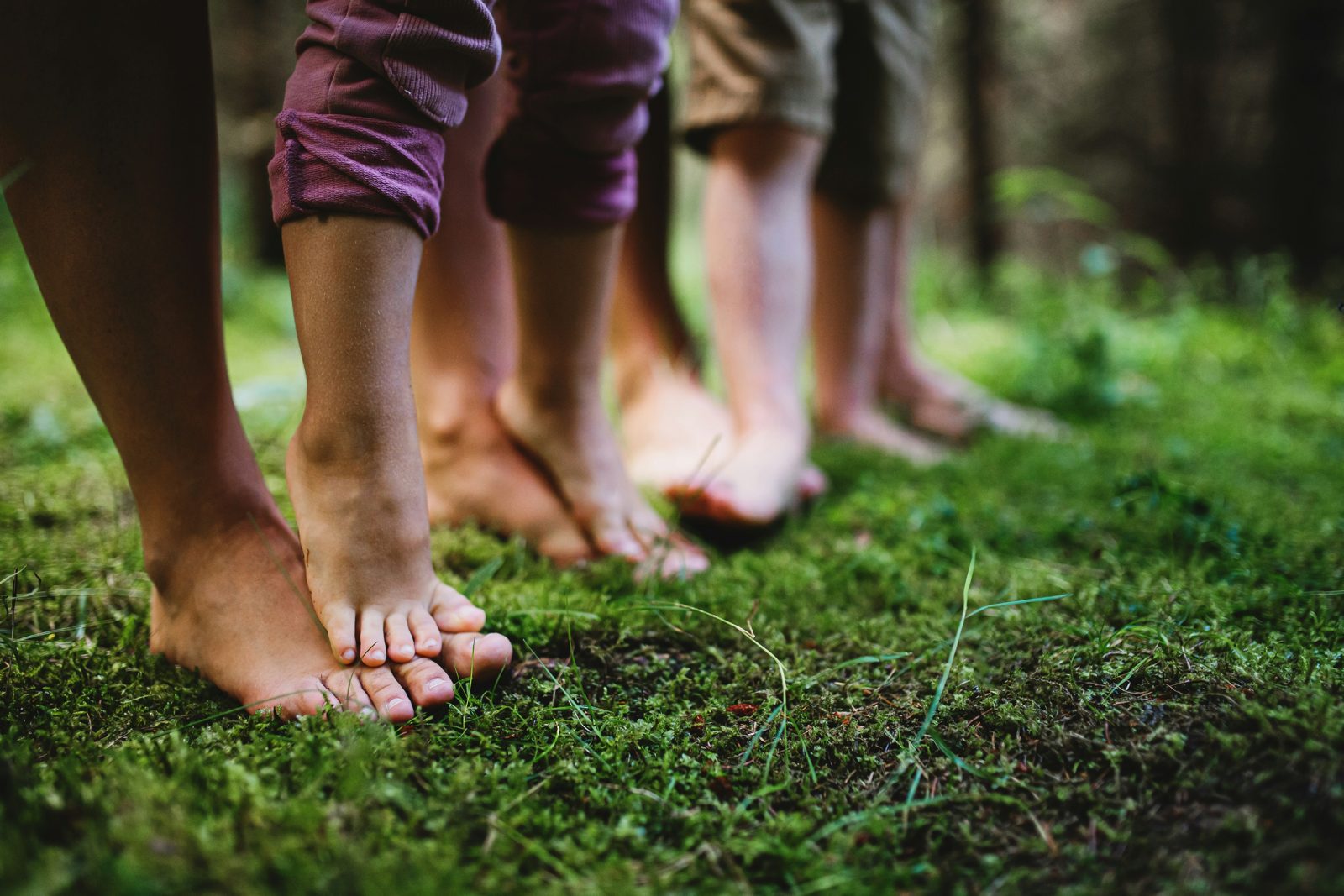
Not long ago I was travelling through Canada, the part of the country where I grew up. The main highway there runs through an Ojibway reservation, and I have driven that road many times, going back to when I was a young woman. Never once had I felt any pull to stop. This time I did. Something called me to pull over, take off my shoes, and literally plant my feet in the ground. It felt like a calling to connect with my roots, and I stood there far longer than I expected to.
I should say that I'm barefoot most of the time anyway. After more than 25 years of yoga, my feet are not my best asset, and I often apologize to my pedicurist because I know she'll have her work cut out for her. I have also wondered, more than once, whether I should be preparing my feet for rough times. If I ever had to run barefoot somewhere, could I do it?
So when this article on grounding popped into my inbox, I was delighted. It felt as though something in the universe might be sending me some good, solid advice that day. A feeling on the side of a highway isn't evidence, of course, and I'll be clear in this piece about what the research does and doesn't show. But it sent me looking, and here is what I found.
Most of us now spend our days indoors, in shoes, and in front of screens. For most of human history it was the opposite: people walked barefoot, sat and slept on the ground, and wore footwear that kept them in contact with the earth. Grounding, also called earthing, is the practice of deliberately restoring that contact. It has a growing following, a small but interesting body of research, and a fair number of big claims. This piece looks at what has actually been studied, what is still only a hypothesis, and how to try it safely.
The Idea Behind Grounding
The central hypothesis is that direct contact with the earth's surface lets the body's electrical potential equalize with the ground's, and that this may steady the electrical environment around cells and tissues. One proposed mechanism is that electrons from the earth enter the body and neutralize reactive oxygen species, the unstable molecules that damage cells when they accumulate. These are produced naturally, and immune cells release bursts of them during injury or infection, which is useful in the short term. When they stay elevated for too long, they can feed chronic inflammation. Some proponents suggest the electrons travel through the body's collagen network to reach areas of injury, which is where the interest in wound healing comes from.
It's worth being clear that this mechanism is a theory, not an established finding. A second, less developed hypothesis proposes that grounding influences the body's bioelectrical state and autonomic nervous system activity, including heart rate variability, a measure of how well the body shifts between “fight or flight” and “rest and digest.” There is also a plainer explanation that doesn't depend on electricity at all: the soles of the feet are rich in sensory receptors, and bare contact with the ground sends the nervous system a dense stream of information. One study found people walking barefoot showed fewer stress-related brain waves and more calming ones.
What the Studies Have Found So Far
The research is real but small, and much of it is pilot-scale. Here is what has been reported, along with the size of each study so you can weigh it fairly:
- Sleep: In a 2025 pilot study, 56 people used either a grounding mat or a non-grounding mat for six hours a day over more than 31 days. The grounded group reported better sleep quality, fewer insomnia symptoms, less daytime sleepiness, lower stress, and more total sleep time.
- Mood: A 2015 pilot study of 40 people found one hour of grounding improved positive mood, while a sham-grounded group showed no change. That suggests an effect beyond simple relaxation.
- Pain, fatigue, and low mood: A small 2018 study of 16 massage therapists found improvements in all three after six weeks of grounding, along with better physical function and energy, some of it lasting a month after the study ended.
- Exercise recovery: In a 2015 study, 32 healthy young men did 200 half-knee bends and were then grounded or sham-grounded for four hours on two days. The grounded group had smaller rises in creatine kinase, a marker of muscle damage. A 2019 study of 22 healthy participants found those who slept on grounded sheets for 10 days after intense downhill running had less soreness, better performance, and lower creatine kinase than a sham group.
- Blood flow: A small 2013 study of 10 healthy adults found two hours of grounding increased the electrical charge on red blood cells and reduced their tendency to clump, which the authors linked to possibly lower blood thickness. A 2012 review made similar suggestions about inflammation and blood flow.
- Heart rate variability: A 2011 study of 27 participants found grounding improved heart rate variability more than relaxation alone. A 2017 study of 26 infants in a neonatal intensive care unit found a skin patch connecting them to the ground cut skin voltage by about 95% and raised a marker of vagal tone by 67%. The researchers noted that more research is needed.
- Blood pressure: In a 2025 study, 32 older adults with hypertension grounded for 30 minutes three times a week for three weeks. Average systolic pressure fell by about 7.8 mmHg and diastolic by about 2.7 mmHg. There was no control group, so this shows an association, not a cause.
- Cognition: A 2024 study of 59 adolescent boys found barefoot walking was associated with faster processing, better concentration, and changes in brain wave activity compared with walking in sneakers. The study did not isolate contact with the earth as the reason.
- Foot strength: A 2025 systematic review of seven studies with 213 adults found barefoot or minimalist-shoe training may improve foot muscle development, arch function, and toe strength. Those benefits come from movement and mechanical loading, and are not evidence for the proposed electrical effects.
The Caveats That Matter
Several of these findings come from small studies, many with short durations, and some from a limited number of research groups. A few of the results are self-reported, and one had no control group at all. Researchers have also pointed out that it's hard to separate the effect of skin-to-earth contact from everything that tends to come with it: sunlight, fresh air, movement, and simply being in nature. A 2022 integrative review concluded that grounding research is affected by many confounding factors and called for larger, high-quality randomized controlled trials before conclusions are drawn. One integrative psychiatrist who has practiced earthing daily for 25 years also cautions that the effects of nature, such as scenery and a sense of relaxation, work differently from earthing and shouldn't be assumed to be the same thing.
The honest summary is that the early signals are interesting, particularly for sleep, stress, and recovery, but they are not yet proof.
A Traditional Perspective
Traditional Chinese medicine offers a different frame. It holds that people are born from the vital energy of heaven and earth and are not separate from their environment, and that grounding reconnects us to nature. The soles of the feet matter in this view because several meridians pass through them, and an acupoint called Bubbling Spring is traditionally used to draw rising activity downward and calm the mind. A TCM practitioner interviewed for the original reporting also noted that people with a cold constitution may be poorly suited to long contact with cold or damp ground. This is a traditional framework rather than a clinically tested one, but it is a thoughtful lens, and its practical advice, to keep warm and pay attention to how your body responds, is sensible whichever view you hold.
How to Practice Grounding
- Walk barefoot on grass, sand, soil, or mud.
- Lie or sit directly on the ground, on grass or sand.
- Wade or swim in natural bodies of water such as the sea, rivers, or lakes.
- When outdoor contact isn't practical, grounding mats, sheets, socks, patches, or blankets are available.
There's no established dose. One OB-GYN quoted in the original piece suggests starting with 10 to 15 minutes of barefoot walking on grass, sand, or soil a few times a week and noticing whether you sleep better, feel calmer, or have less discomfort. An integrative counselor notes that even five or ten minutes can be a good chance to slow down. A longtime practitioner recommends working up to at least 50 minutes a day, but that is one practitioner's guideline rather than a researched standard.
A word on products: the evidence for grounding sheets and mats is more limited than the evidence for direct contact with the earth. Their conductivity also matters. Silver fibers can oxidize and lose conductivity without any visible sign, stainless steel resists oxidation better, and manufacturers don't appear to publish long-term or post-wash conductivity data, so it's difficult to verify a product keeps working.
Cautions
- Outdoor hazards: Bare skin on the ground means ordinary outdoor risks, including cuts, burns, insect bites, pollen and other allergens, contaminated soil or water, pesticides, and sharp objects. Take extra care during pregnancy, since soil can carry contaminants or infectious organisms.
- Infection risk: If you are neutropenic (have a low white blood cell count) from chemotherapy, or you have diabetes, you need to be especially careful. Chemotherapy can leave the body less able to fight the bacteria and fungi found in soil and natural water, and diabetes can reduce sensation in the feet and slow healing, so a small cut or blister may go unnoticed and turn into a serious infection. Talk with your doctor or care team before trying barefoot contact with the ground, and if you are cleared to try it, check your feet carefully every day.
- Equipment safety: Use products designed for grounding and follow the manufacturer's instructions. Never connect grounding equipment directly to household wiring, have an electrician verify that outlets are properly grounded before use, and avoid grounding devices during thunderstorms.
- Implanted devices: Anyone with a pacemaker, insulin pump, or similar device should check with their doctor before using grounding equipment.
- Swimming: Natural water brings its own risks, including waterborne illness, currents, weather, and drowning.
- Cold or damp conditions: People who run cold, particularly in the hands and feet, may find prolonged contact with cold or damp ground uncomfortable or unsuitable.
The Takeaway
Whether or not electrons from the earth do anything measurable inside the body, the broader idea behind grounding is hard to argue with. Time outdoors, moving your body, giving your nervous system something real to feel, and slowing down all have their own well-supported benefits. For most healthy people, a few minutes barefoot on grass is a low-risk, no-cost experiment. Try it with an open mind and a clear head about what has and hasn't been proven, and let your own sleep, mood, and energy tell you whether it's worth keeping.
This piece draws on and credits the original reporting by Mercura Wang, “Grounding: The Practice of Reconnecting With Earth—Here Are 14 Potential Benefits,” medically reviewed by DeMario Butts, M.D., M.S., published in The Epoch Times, September 27, 2026 (updated October 4, 2026).
This content is for educational purposes only and is not a substitute for professional medical advice. Please consult your doctor or care team before making any changes to your diet, supplements, or treatment plan.
“I know that I know nothing.”— Socrates