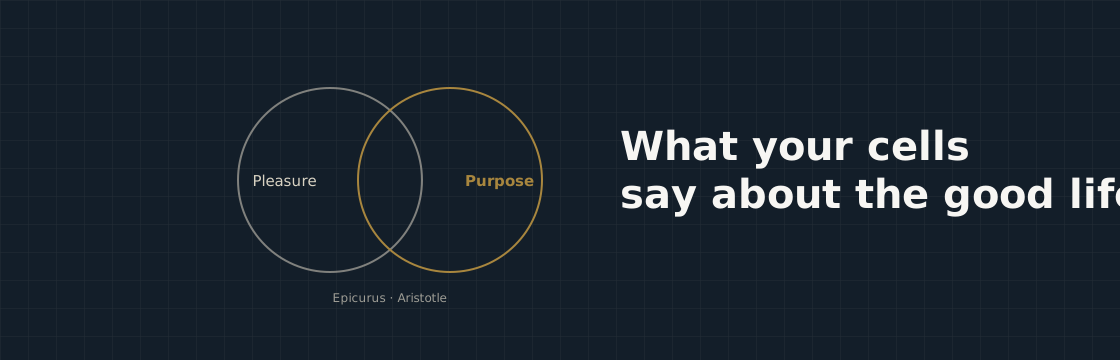
What actually makes a life good? More than two thousand years ago, two Greek philosophers gave two very different answers — and it turns out modern science has something real to say about which one your body agrees with.
This piece was inspired by an excellent article by Makai Elías Calles, published in The Epoch Times (September 2026), which traces this question from ancient Athens into the immunology lab. I want to walk through the ideas here, because they land right at the center of what I believe about health: that mind, body, and spirit were never meant to be treated separately.
Two Answers From Ancient Athens
Around 300 B.C., the philosopher Epicurus watched how newborn creatures moved instinctively toward comfort and away from pain, and concluded that nature's basic instruction to every living thing is simple: seek pleasure, avoid pain. But he didn't mean feasts and indulgence. For Epicurus, the highest pleasure was the absence of pain in the body and disturbance in the mind — a state reached not by acquiring more, but by wanting less. He sorted human desires into three categories: what's natural and necessary (food, shelter, safety), what's natural but not necessary (fine food, comfort), and what's empty and limitless (fame, power, endless wealth) — warning that the last basket can never be filled, no matter how much you pour into it.
Aristotle took a different route entirely. He noticed that every want traces back to the same root: we want money for what it buys, health for what it allows, and all roads eventually lead to one final answer — happiness. But he argued pleasure itself couldn't be the highest form of happiness, because a life spent chasing it is, in his words, a life fit for grazing cattle. Instead, he asked what makes a human being distinct at all — not simply alive, and not simply capable of sensation and movement — and concluded it was our capacity to reason and choose. True happiness, or eudaimonia, comes from exercising virtue: courage, honesty, generosity, self-control, practiced consistently as habits, not held as ideals. As Aristotle put it, “We become just by doing just acts, and brave by doing brave acts.” In his view, pleasure still shows up — just later, as the natural companion of a life well lived, rather than the goal of it.
What Your Cells Have to Say About It
In 2013, researchers drew blood from people whose sense of happiness leaned more hedonic (pleasure-seeking) versus more eudaimonic (meaning-seeking) and looked at gene expression in their immune cells. The pleasure-leaning group showed more activity in inflammatory genes — the kind linked to heart disease, cancer, and accelerated aging. The meaning-leaning group showed the opposite: lower inflammatory gene activity, and more activity in genes involved in antiviral defense.
Later research has since softened the idea that pleasure itself is harmful — moderate, Epicurean-style pleasure doesn't appear to carry the same inflammatory signature. But purpose and meaning, especially meaning built through connection with other people, consistently shows up with a favorable inflammatory profile of its own.
A Reason to Get Up Tomorrow
The clearest demonstrations of this come from long-term studies of purpose in older adults. One research team in Chicago followed more than 900 older adults for up to seven years and found that those with the strongest sense of purpose were about two and a half times more likely to remain free of Alzheimer's disease than those with the weakest sense of purpose.
A similarly striking finding comes from Japan's concept of ikigai — roughly, “a reason to live.” Researchers asked more than 43,000 Japanese adults whether they had ikigai in their lives. Seven years later, those who said no were about 50 percent more likely to have died in that period than those who said yes.
The Intention Behind the Purpose Matters
One more detail from this research is worth sitting with. When researchers followed older adults who volunteered and asked why, some said they did it to help others; some admitted it was mostly for themselves — to feel better, meet people, or get out of the house. Four years later, only the ones who volunteered to help others showed a survival benefit. The ones who did it mainly for themselves showed none at all.
The benefit didn't come from the activity itself. It came from where the purpose was pointed. Outward-facing purpose — the kind Aristotle described as virtue lived out toward other people — appears to matter for your health in a way that self-focused purpose simply doesn't.
Where This Leaves Us
I don't think these two ancient answers need to compete. Enjoy the real, moderate pleasures of life the way Epicurus described — rest, good food, a calm mind, the absence of unnecessary suffering. And alongside that, build a life organized around purpose and virtue the way Aristotle described — something that points outward, toward the people around you, practiced as a habit rather than a mood. The research increasingly suggests your immune system, your brain, and your lifespan are all quietly keeping score of which one you're choosing, day to day.
This piece draws on and credits the original reporting and synthesis by Makai Elías Calles, “What is a good life?”, published in The Epoch Times, September 18–19, 2026.
Please noteThis content is for educational purposes only and is not a substitute for professional medical advice. Please consult your doctor or care team before making any changes to your diet, supplements, or treatment plan.
“I know that I know nothing.”— Socrates